Home
HomeEV Motor Bearings: Solving Electrical Current Damage in Needle Roller Bearings [EDM Fluting Prevention Guide]
 2026-05-17
 0
0
Audience: EV powertrain engineers, motor design teams, fleet maintenance leads
TL;DR: Variable-frequency drive (VFD) inverters on EV traction motors induce common-mode shaft voltages that discharge through the needle bearing as miniature lightning strikes. Each discharge melts microscopic craters; over months these merge into the characteristic fluting or washboard wear pattern, causing premature bearing failure. DW Bearing addresses this with three engineered solutions: hybrid ceramic rollers, insulated coatings, and current-bypass shaft grounding.
1. The Problem: Why EV Motor Bearings Fail Differently Than ICE Bearings
In conventional internal-combustion engine (ICE) vehicles, needle bearings see mechanical loads only. In electric vehicles, the traction motor adds a second failure mode rooted in the drive electronics, not mechanics.
Modern EV traction inverters use silicon-carbide (SiC) or insulated-gate bipolar transistor (IGBT) modules switching at 10-20 kHz with edge rates dV/dt reaching 5-10 kV/µs. These fast edges couple capacitively through the motor stator-rotor air gap, inducing a common-mode voltage of 5-40 V peak on the rotor shaft relative to the motor housing (ground).
When this voltage exceeds the breakdown strength of the lubricant film inside the bearing (typically 3-7 V/µm depending on grease type and temperature), the energy discharges across the rolling element-raceway contact — a phenomenon known as Electrical Discharge Machining (EDM).
2. How EDM Damage Develops in a Needle Bearing
Stage 1 — Frosting (0-50 hours of EV duty cycle): Microscopic pits 1-5 µm in diameter appear on the raceway. Visible only under SEM at 1,000x. No measurable performance impact yet.
Stage 2 — Pitting (50-500 hours): Pits enlarge to 10-20 µm and begin clustering. Bearing noise increases by 3-6 dB. Vibration FFT shows new peaks at cage-train frequencies.
Stage 3 — Fluting / Washboard (500-2,000 hours): Pits align into parallel ridges perpendicular to bearing axis, spaced equal to the needle-to-needle pitch. Noise becomes audible as a high-pitched whine. Torque ripple visible on dyno traces.
Stage 4 — Catastrophic failure: Lubricant breaks down from arc-generated heat (local temperatures 10,000+°C at the discharge channel). Bearing seizes or generates metallic debris that contaminates motor windings.
3. Detection: How to Diagnose Bearing Electrical Damage
Visual / Microscopy
Stereo microscope (40x): Fluting marks visible as evenly-spaced grey transverse bands
SEM at 500x: Crater morphology with raised rim characteristic of arc melting (vs. mechanical pitting, which has sharp edges)
Vibration Signature
FFT spectrum shows peaks at cage-train pass frequencies and harmonics — distinct from mechanical fatigue spalling, which shows ball-pass frequency on inner/outer ring (BPFI / BPFO)
Velocity rms increases 2-3x over baseline within first 200 hours of EV operation
Shaft Voltage Measurement
Use a high-impedance probe (10 MΩ minimum, AC-coupled, 100 MHz bandwidth) with a brush contact on the rotor shaft, ground return to motor housing
Healthy motor: < 1 V common-mode peak
Risk threshold: > 8 V peak triggers EDM in standard greased needle bearings
4. Engineering Solutions (Trade-off Matrix)
| Solution | Cost vs Standard | Discharge Voltage Tolerance | Typical EV Use Case |
|---|---|---|---|
| Insulated ceramic outer ring (Al₂O₃ coating) | +150% | 2,000+ V | Premium EV traction motors |
| Hybrid ceramic rollers (Si₃N₄ needles) | +200% | 5,000+ V | High-end performance EVs |
| Conductive grease (carbon-additive) | +30% | 15 V (raised threshold) | Cost-sensitive HEV |
| Shaft grounding ring (external) | +50% system cost | Bypasses current entirely | Most common OEM solution |
| Standard greased needle bearing | baseline | 3-7 V | ICE only, NOT recommended for EV |
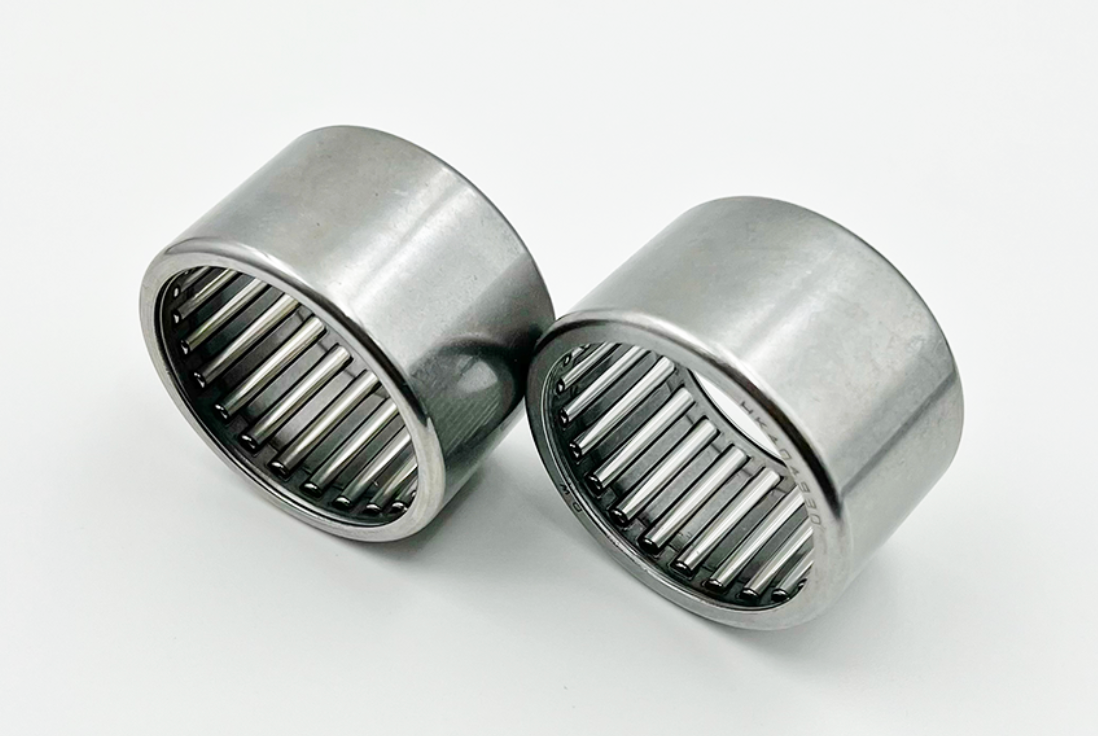
5. DW Bearing EV-Rated Needle Bearings
DW developed three product lines specifically for EV applications:
HK-EV series: Standard drawn-cup HK bearings with proprietary insulated outer-cup coating, rated 2,000 V withstand voltage, 100% interchangeable with standard HK boundary dimensions
NK-EV-HC series: Machined needle bearings with hybrid ceramic Si₃N₄ rollers — for high-performance traction motors
AXK-EV series: Thrust needle bearings with insulated washers for EV planetary reducer applications
All EV series tested to IEC 60034-25 (electrical insulation for variable-speed drives) and validated on 5,000-hour endurance protocols with our automotive customers.
6. Case Study: 2024 NEV Manufacturer Field Failure Resolution
A 2024 plug-in hybrid program from a Chinese NEV OEM reported needle bearing whine complaints from customers at 8,000-12,000 km mileage. Failure investigation:
Bearings disassembled showed Stage 3 fluting on the inner raceway
Shaft voltage measurement on test vehicles showed 18-24 V common-mode peak during high-speed regenerative braking
Root cause: SiC inverter dV/dt was 8 kV/µs, exceeding standard bearing rating
DW worked with the OEM to deploy HK-EV insulated bearings as a running change at production week 47. Field returns for whine complaints dropped from 0.8% to <0.05% over the next 18 months of production.
7. Selection Checklist for EV Bearing Specification
Identify inverter switching frequency and dV/dt
Measure shaft voltage on prototype vehicle
Calculate apparent bearing current density (target: <0.1 A/mm²)
Specify insulated, hybrid, or shaft-grounding solution per voltage envelope
Validate with 1,000-hour accelerated EDM endurance test (IEC 60034-25)
Confirm grease compatibility with high-frequency operation
8. FAQ
Q1: Can I just use a regular HK needle bearing in an EV motor?
Only if the shaft is already grounded externally (most common OEM solution). Without grounding, fluting damage begins within 50-200 hours.
Q2: What is the difference between fluting and brinelling?
Both create marks on raceways, but fluting from EDM has even spacing (matching roller pitch), discoloration from arc heat, and microscopic melt rims. Brinelling from impact loading shows individual indentations, no discoloration, and sharp edges.
Q3: How long does DW HK-EV bearing last in EV duty cycle?
Tested to 5,000+ hours equivalent of 200,000 km vehicle service at 18 V shaft voltage — no measurable EDM damage in post-test microscopy.
Q4: Are EV bearings compatible with existing motor designs?
Boundary dimensions are 100% identical to standard HK / NK series. Only difference is the insulating coating on outer cup, which adds <5 µm to outer diameter — within standard housing tolerance.
Q5: How much does an EV-rated bearing cost vs. standard?
HK-EV insulated: +150% standard HK price. NK-EV-HC hybrid ceramic: +200%. Considering a typical bearing failure causes 8,000-15,000 RMB downtime + warranty claim, the EV-rated bearing pays back within first prevented failure.
9. References
IEC 60034-25:2014 — Rotating electrical machines, guidance for converter-fed machines
IEEE 1551 — Standards for electrical bearing currents in adjustable-speed drives
NEMA MG1 Part 31 — Definite-purpose inverter-fed motors
Muetze, A. (2004) Bearing currents in inverter-fed AC motors — TU Darmstadt PhD thesis
SKF Technical Report SKF/EE/2018 — Electrical damage in rolling bearings
About the Author: DW Bearing Engineering Team. EV bearing program led by senior application engineer with 12+ years in inverter-fed motor reliability.
Related products: Drawn Cup Needle Roller Bearings | Machined Needle Roller Bearings | Automotive Bearing Applications
EV bearing engineering consultation? Email [email protected].